
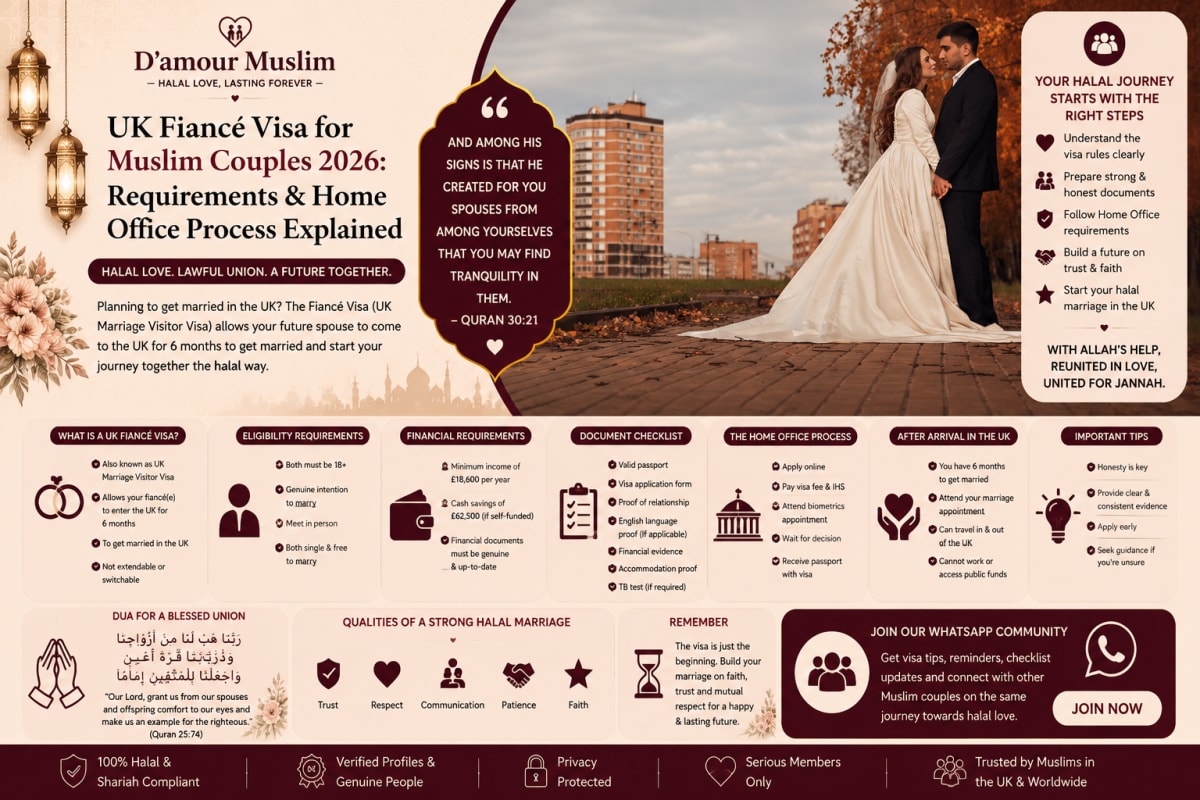
UK Fiancé Visa for Muslim Couples 2026: Requirements & Home Office Process Explained
Introduction
Getting engaged for a Muslim woman who is separated from a Muslim man by the border can be a confusing yet exciting experience. Perhaps one person lives in Birmingham or Manchester while the other is in Lahore, Islamabad, or Karachi. The families may have already been talking about the Nikah, wedding arrangements, home life, etc., and the Muslim couple in 2026 is working on gaining an understanding of immigration to the UK.

For eligible Muslim fiancés/fiancées, the UK fiancé visa may be an option to enter the UK to marry in the UK. But that is not the same with the immigration process and the Islamic marriage process. This knowledge will help you avoid costly mistakes and family chaos.
What Is a UK Fiancé Visa?
A family visa is one of the visa categories under UK immigration visas. It enables a fiancé or fiancée (or proposed civil partner) to move to the UK to marry within six months of their arrival or enter a civil partnership if that is the case. The road is a temporary road with immigration conditions. For a Muslim man and woman, this should be considered immigration permission in 2026, rather than an Islamic marriage contract.
Who is eligible for a UK fiancé visa?
A typical scenario of an application is that both partners are 18 years or older, that one of the partners is in the UK, that they have a genuine relationship, and that they intend to marry within six months in the UK. Widows and widowers must have been married or in a civil partnership before, and the applicants will typically have to meet financial and English language standards. The UK-based partner could have to be a British or Irish citizen or be settled in the UK or have another immigration status that meets the requirements of the Family Visa rules.
Are Muslim couples eligible for a UK fiancé visa?
Yes. Are there any Muslims who can apply for a fiancé visa to the UK? There is no prohibition on the application of an eligible couple based on the fact that one or both of them are Muslims. It is the Home Office that decides on immigration and not the type of religion that a couple follows. But Muslim married couples need to take care regarding the time of engagement, fiancé visa, Nikah, civil marriage, and the ceremony of marriage.
Under Islamic law a fiancé visa does not create a marriage relationship between two parties. If couples have any personal questions regarding when to perform their Nikah, they should consult with a qualified local scholar, and if they have any immigration-related questions, they should consult a qualified immigration professional.
Fiancé Visa Financial Requirement in the UK
The usual minimum income is £29,000 per year for applications made under the current rules of the partners. This is not to say that each applicant must make £29,000 themselves. The eligibility of income and evidence is subject to the rules that apply.
There may be certain conditions where other financial rules or exceptions may apply. Do not use an old article, social media post, or advice from friends as a source of financial guidance; this should be done via the latest GOV.UK guidance.
English Language Requirement
Unless exempted, an applicant must be capable of communicating in English. There is current guidance on GOV.UK for some applicants to be able to use a qualifying degree that has been taught in English or an approved secure English language test. The minimum test level is normally A1 for a first application (unless exempt). Tests and immigration requirements may also change; please see the most up-to-date list on GOV.UK before booking a test.
Documents Muslim Couples May Need
The list is not intended as a comprehensive list of evidence but is intended for reference only and will be determined by the circumstances. Some evidence is common, such as
- Any valid travel document or current passport.
- Relationship evidence
- Financial evidence
- English language evidence
- Evidence of past marriage(s)
- Relevant accommodation information
- Immigration history
- Supporting evidence of true marriage plans
Certified translations of documents not in English or Welsh may also be required for the applicant. GOV.UK details that there may be more evidence required depending on the application. Relationship evidence may be particularly helpful in a couple's case in 2026, where they are living apart in Pakistan and the UK. Where the couple isn't together, through communication, visits, financial support, and time together, this can be a way of demonstrating that there's an ongoing genuine relationship.
How to Apply for the UK Fiancé Visa
The UK fiancé visa process can be broken down into a series of steps:
- Step 1: Determine if both partners are eligible under the eligibility criteria
- Step 2: Review the current financial need and evidence guidelines
- Step 3: Review the English language requirements/exemptions
- Step 4: Collect relationship, financial, and supporting documents
- Step 5: Fill out the online application form (if the applicant is outside the UK)
- Step 6: Follow the instructions for identity and biometric information
- Step 7: Give the supporting evidence that is required
- Step 8: Await home office decision
Applications for visas from outside the UK are normally processed within 12 weeks of the application being made, but may take longer in some cases, according to current guidance on GOV.UK. Please ensure that travel or wedding plans are made with the latest service information.
What Happens Once You Are in the UK?
A fiancé visa typically grants a visa for a 6-month period. The couple have to get married or form a civil partnership during this time. During this time the fiancé visa holder is not able to work or study. Once the applicant is married, he or she usually must apply to be authorized to stay as a spouse. If the application is approved, work and study will be allowed under the following conditions.
Nikah, Civil Marriage and the Fiancé Visa
This is one of the most crucial aspects for Muslim couples. Immigration permission is a fiancé visa. Nikah is an Islamic marriage contract. A civil marriage is the legal marriage process as recognized by UK law. A marriage certificate will confirm a legally recognized marriage, and a subsequent spouse visa application will be an immigration application based on a marriage or a qualifying partnership. A Nikah is not a document sufficient to meet the UK immigration requirements. Muslim married couples need to know their responsibilities in Islam as well as the legal requirements for marriage before they are able to plan their wedding.
What Happens After Marriage?
The fiancé route does not become a spouse visa after the marriage has been completed. The applicant generally needs to make the appropriate further family visa application as a partner. There are also specific requirements for that application, such as financial and English language requirements (where relevant). Never take marriage for granted as a means of extension, settlement, or citizenship. Some of the common mistakes Muslim couples should avoid are the following:
- If there is an engagement, then it is assumed to be enough for the visa
- Giving some evidence of a relationship but not strong enough
- Not paying attention to the financial needs
- The information on immigration in the UK is outdated
- A marriage that has been registered in the UK automatically adheres to the country's immigration regulations
- Not remembering the six-month marriage period
- Holders of the fiancé visa can continue to work in Germany
- Waiting till the last minute to submit the next visa application
- Not submitting complete or accurate documents
Become a part of our growing Muslim marriage community!
When searching for marriage opportunities with a Muslim girl, it's important to consider D'amour Muslim, which offers a respectful and faith-informed setting for Muslims seeking marriage connections. To join our Muslim marriage WhatsApp community, call 07831899605 or +447831899605.
The community brings together those looking for marriage opportunities from all over London, Birmingham, Manchester, the UK, Pakistan, and the international Muslim community. D'amour Muslim is not an immigration service, the Home Office, or a legal firm that represents or secures visas for people.
Fill out Your Muslim Marriage Profile
Go to https://damourmuslim.com/ and register on the site, enter your Muslim marriage profile and preferences, and let others know what you are looking for in a spouse. If you're searching for UK Muslim marriage opportunities, Pakistani Muslim marriage connections, or serious halal marriage matches, take a moment to speak truly and incorporate your family suitably.

Frequently Asked Questions
Is it possible for Muslims to apply for a UK fiancé visa?
Yes. If the Muslim applicant satisfies the criteria for a family visa in the UK, then he can seek a fiancé visa. "Eligible application" means you don't need to forget your religion while applying.
What is the required income for a UK fiancé visa in 2026?
In principle, the partner visa route requires an income of at least £29,000 per year (depending on the criteria and circumstances). Please see the most up-to-date GOV.UK financial guidance before applying.
How much time can be spent in the UK on a fiancé visa?
Normally a fiancé or fiancée or proposed civil partner will be allowed to stay for six months. The couple have to get married or form a civil partnership within the time limit.
Are you eligible to apply for a UK fiancé visa?
No. Fiancé visa route individuals are not allowed to work or study in their 6-month visa period. They require the proper additional permission to work/study after they get married.
Is it possible to marry on a UK fiancé visa?
The visa is not a factor in whether a Nikah is Islamically valid or not. Muslim couples must know the Islamic and UK law requirements of marriage separately before they arrange their marriage (Nikah) and civil marriage.
What is the next step after marriage for a UK fiancé visa?
Normally, a spouse must apply to extend their stay as a spouse. Each subsequent application will come with its own set of immigration requirements and should be prepared before the end of the fiancé's permission.
Conclusion
Muslim married couples who are planning to marry with their UK fiancées and settle in the United Kingdom could be interested in the UK fiancé visa. But preparation matters. Know financial and English needs; gather true relationship proof; be aware of the 6-month marriage time frame; and maintain the separation of Nikah, civil marriage, and immigration status. Before making an application, it is important for couples from Pakistan or other countries to review the most up-to-date GOV.UK information, as immigration laws are subject to change.
If you plan carefully, communicate with a firm hand and get the professional help you need, the process from engagement to marriage in the UK can be a bit easier. For those seeking a serious halal marriage opportunity, simply join D'amour Muslim on WhatsApp, set up a profile, and look for authentic Muslim marriages, and be honest and have good intentions.